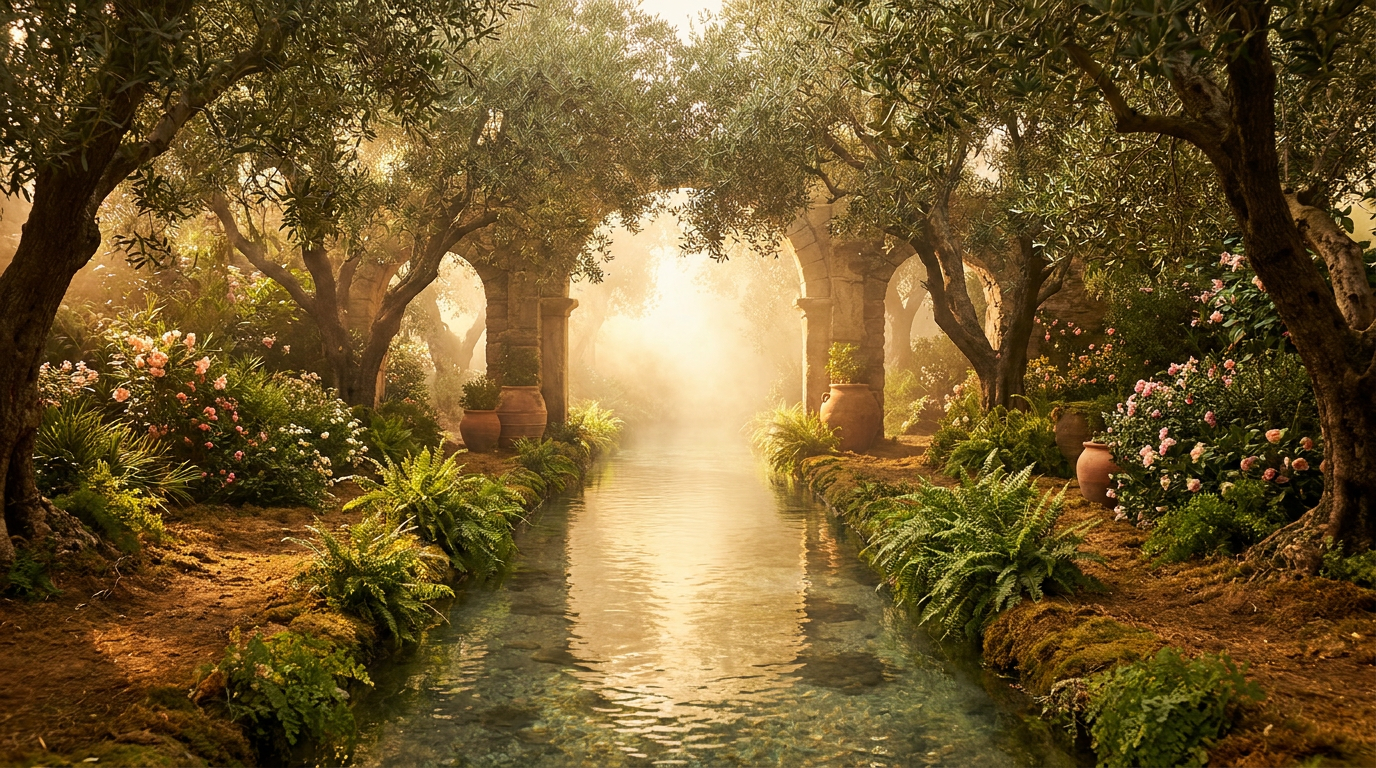
The River of Life - Part 2
The Books of Ezekiel & Revelation: Refers to a river flowing from the throne of God, with trees on either side bearing fruit for food and leaves for the healing of nations. It can also be a symbol of Spiritual Renewal, the constant flow of peace, grace, and life-giving presence from the Holy Spirit of God.
Title - THE RIVER OF LIFE - Pat 2
The Flow of God's Presence, the Fullness of the Holy Spirit, and the Abundance of Eternal Life
Foundational Scriptures: Ezekiel 47:1–12; Psalm 46:4; John 4:13–14; John 7:37–39; Revelation 22:1–5.
INTRODUCTION: THE RIVER THAT FLOWS FROM GOD
Throughout Scripture, the river is a powerful representation of God's presence, divine life, spiritual renewal, healing, fruitfulness, and eternal fellowship with Him.
From the river that flowed through the Garden of Eden to the river of living water described in the New Jerusalem, Scripture reveals a profound spiritual truth: God is the source of life, and everything connected to His life-giving presence can experience renewal, growth, and fruitfulness.
The River of Life is more than a symbol of refreshment. It represents the continuous supply of divine life flowing from the throne of God, bringing transformation wherever it goes.
Natural rivers sustain ecosystems, nourish vegetation, refresh the thirsty, and support communities. Similarly, the River of Life represents God's power to sustain the human spirit, restore what is broken, and bring spiritual fruitfulness into places previously characterized by barrenness.
The River of Life speaks of five great spiritual realities:
The source of life — God Himself. The presence of God — the atmosphere of divine fellowship. The power of the Holy Spirit — the living water flowing through believers. The transformation of life — healing, renewal, and fruitfulness. The fullness of eternity — everlasting life in the presence of God and the Lamb.
The invitation of Scripture is not merely to observe this river but to receive the life it represents and live in the fullness of God's presence.
1. THE RIVER OF LIFE FLOWS FROM THE THRONE OF GOD Revelation 22:1–2
John describes a river of the water of life, clear as crystal, flowing from the throne of God and of the Lamb. Alongside the river stands the tree of life, bearing fruit continually, with leaves associated with the healing of the nations.
This remarkable vision reveals the ultimate source of divine life.
The river does not originate from human effort, religious institutions, political power, or earthly resources.
It proceeds from the throne of God and of the Lamb.
The throne represents God's sovereignty, authority, majesty, and eternal government.
The river represents the life that proceeds from His presence.
The relationship between the throne and the river teaches an important spiritual principle:
Where God's authority is acknowledged, His life-giving presence is welcomed.
The river flows from the throne because true life originates in God.
Jesus Christ, the Lamb, is central to this vision. Through His redemptive work, humanity is offered reconciliation with God and the gift of eternal life.
The river therefore reminds believers that spiritual life is not self-generated. It is received through a living relationship with God through Jesus Christ.
Spiritual lessons
A person may possess wealth, influence, education, and worldly accomplishments yet remain spiritually empty.
Conversely, someone who lives in fellowship with God can experience peace, hope, and spiritual abundance even amid difficult circumstances.
The fullness of life is not ultimately measured by possessions but by communion with the Giver of life.
The greatest blessing of the River of Life is not merely what flows from God, but the privilege of knowing God Himself.
2. THE RIVER OF LIFE IN THE GARDEN OF EDEN Genesis 2:10–14
The Bible first introduces a river in the Garden of Eden.
A river flowed out of Eden to water the garden and then divided into four branches.
This river was part of God's provision for the flourishing of His creation.
Eden was a place of divine fellowship, abundance, beauty, productivity, and harmony.
The river sustained the garden, illustrating the importance of water to life and fruitfulness.
When viewed alongside the wider biblical theme of living water, Eden becomes a beautiful picture of God's original intention for humanity: life in fellowship with Him.
Humanity was created not merely to survive but to flourish under God's loving care.
Sin disrupted that fellowship, introducing alienation, suffering, and death.
Yet the biblical story does not end with humanity's expulsion from Eden.
It moves toward restoration through Jesus Christ and culminates in the New Jerusalem, where the River of Life and the tree of life appear again.
From Eden to the New Jerusalem
The movement from Genesis to Revelation reveals the unfolding story of redemption.
In Genesis, humanity loses access to the tree of life.
In Revelation, the redeemed enjoy access to the tree of life in the presence of God.
In Genesis, sin brings separation.
In Revelation, God's servants see His face.
In Genesis, the curse enters human experience.
In Revelation 22:3, the curse is no more.
The River of Life is therefore part of the biblical picture of God's ultimate restoration of creation and eternal fellowship with His people.
3. THE RIVER THAT MAKES GLAD THE CITY OF GOD Psalm 46:4
"There is a river, the streams whereof shall make glad the city of God, the holy place of the tabernacles of the most High." — KJV
Psalm 46 presents God as the refuge and strength of His people.
The psalm describes frightening circumstances: the earth changing, mountains shaking, and waters roaring.
Yet amid these images of instability, the psalm introduces a river whose streams bring gladness to the city of God.
The contrast is remarkable.
Outside the city, waters roar with destructive force.
Within the city, the river brings peace and gladness.
The passage reminds believers that God's presence provides stability amid life's uncertainties.
The river represents the assurance that God's people are not abandoned in times of crisis.
The river of divine gladness
There is a joy that depends on favorable circumstances, and there is a deeper joy rooted in knowing God.
Circumstances may change.
Relationships may become strained.
Financial resources may fluctuate.
Health may be challenged.
Nevertheless, the believer can find spiritual strength in the presence of God.
The river of divine gladness speaks of the inward assurance that God remains faithful even when outward conditions are unstable.
The presence of God is the believer's deepest source of peace, strength, and enduring joy.
4. THE RIVER FLOWING FROM THE TEMPLE: THE VISION OF EZEKIEL Ezekiel 47:1–12
One of the most remarkable prophetic descriptions of life-giving water appears in Ezekiel 47.
The prophet sees water flowing from beneath the threshold of the temple.
Initially, the water is shallow.
As Ezekiel is led farther into the river, its depth progressively increases.
The measurements reveal four stages:
| Stage | Depth of water Spiritual application |
|---|---|
| First measurement | Ankle-deep The beginning of spiritual growth |
| Second measurement | Knee-deep Increasing dependence on God |
| Third measurement | Waist-deep Greater surrender and spiritual maturity |
| Fourth measurement | Waters deep enough to swim in A picture of complete dependence upon God's sustaining power |
These applications are devotional interpretations of the passage rather than meanings explicitly assigned to the measurements by Ezekiel.
A. Ankle-deep waters: The beginning of spiritual life
The ankle-deep stage can illustrate the beginning of a person's spiritual journey.
At this stage, the believer is learning to walk with God through prayer, Scripture, obedience, and fellowship.
The foundations of faith are being established.
Spiritual growth begins with a willingness to respond to God's invitation.
B. Knee-deep waters: The life of prayer and dependence
The knees are often associated with prayer, humility, and surrender.
Knee-deep waters can therefore illustrate a growing recognition that human strength is insufficient for the demands of spiritual life.
Prayer becomes more than an occasional religious activity.
It becomes a continual expression of dependence upon God.
C. Waist-deep waters: Spiritual strength and surrender
The waist is associated with bodily stability and movement.
Waist-deep waters can symbolize a stage in which spiritual convictions increasingly shape everyday conduct.
The believer begins to demonstrate greater maturity in decisions, relationships, responsibilities, and service.
Faith becomes more deeply integrated into daily life.
D. Waters deep enough to swim in: The fullness of surrender
Eventually, Ezekiel encounters waters too deep to cross on foot.
The river has become a body of water in which a person must swim.
This image can illustrate the transition from relying primarily on personal control to living in deeper dependence upon God.
It points toward a life increasingly governed by trust, obedience, and responsiveness to the Holy Spirit.
The spiritual journey is not merely about entering the river but growing in the knowledge of God and yielding more completely to His will.
5. WHEREVER THE RIVER FLOWS, LIFE FLOURISHES Ezekiel 47:8–9
Ezekiel's vision describes the waters flowing toward the eastern region and entering the sea.
The water brings healing, and living creatures flourish wherever the river flows.
This is one of the most profound features of the vision.
The river does not merely sustain what is already alive.
It brings life into places associated with death and barrenness.
The transforming power of God's presence
Spiritually, this imagery reminds us that God's grace can bring renewal into seemingly hopeless circumstances.
A hardened heart can become tender.
A broken relationship can experience reconciliation.
A discouraged person can recover hope.
A spiritually stagnant life can experience renewal.
A family wounded by years of conflict can begin a journey toward forgiveness and restoration.
These changes do not always happen instantly, and spiritual faith does not eliminate every difficulty. Nevertheless, the life-giving grace of God makes genuine transformation possible.
The river and the healing of nations
Ezekiel 47 also describes trees growing along the riverbanks, producing fruit for food and leaves for healing.
Revelation 22 similarly describes the tree of life and its leaves for the healing of the nations.
Together, these passages direct attention toward God's restorative purposes.
They remind believers that God's redemptive plan extends beyond individual spiritual experience.
It encompasses the ultimate renewal of creation and the gathering of people from the nations into His eternal kingdom.
The River of Life reveals a God whose purposes include restoration, reconciliation, and everlasting life.
6. JESUS CHRIST: THE GIVER OF LIVING WATER John 4:13–14
Jesus encounters a Samaritan woman at Jacob's well.
During their conversation, He distinguishes ordinary water from the living water He offers.
Natural water temporarily satisfies physical thirst.
The living water Jesus gives becomes an enduring source of life within the recipient, springing up into eternal life.
The contrast reveals an essential truth about human existence.
Human beings experience different forms of thirst.
There is physical thirst for water.
There is emotional thirst for love and acceptance.
There is intellectual thirst for understanding.
There is spiritual thirst for meaning, forgiveness, and reconciliation with God.
Earthly achievements may satisfy some legitimate human desires, but they cannot replace the eternal life offered through Jesus Christ.
The fountain within
Jesus describes living water as a spring arising within the person who receives it.
This is a remarkable promise.
The believer is not merely invited to approach an external source of refreshment.
Through Christ, the believer receives a new and enduring spiritual life.
This life is rooted in God's grace rather than human achievement.
The Samaritan woman's encounter with Jesus also demonstrates that the invitation to receive living water transcends social barriers, cultural divisions, and personal history.
No human past is beyond the reach of God's invitation to eternal life through Jesus Christ.
7. THE HOLY SPIRIT: RIVERS OF LIVING WATER John 7:37–39
During a Jewish festival, Jesus publicly invites the thirsty to come to Him and drink.
He declares that rivers of living water will flow from within those who believe in Him.
John explains that Jesus was speaking about the Holy Spirit, whom believers would receive.
This passage provides one of Scripture's clearest connections between living water and the ministry of the Holy Spirit.
A. The Holy Spirit as the source of spiritual refreshment
The Holy Spirit renews and strengthens believers in their walk with God.
He comforts, teaches, guides, and helps them remain faithful to Christ.
Through His work, believers grow in love, joy, peace, patience, kindness, goodness, faithfulness, gentleness, and self-control.
These qualities reflect the fruit of the Spirit described in Galatians 5:22–23.
B. The Holy Spirit as the power for spiritual transformation
The Christian life is not sustained merely by human determination.
God works within believers through the Holy Spirit, transforming their attitudes, desires, and conduct.
The Spirit directs attention toward Jesus Christ and empowers believers to live in ways that honour Him.
C. The Holy Spirit as the river that flows outward
Jesus speaks not merely of a single stream but of rivers of living water.
This imagery emphasizes abundance and overflow.
The work of the Holy Spirit is not intended to produce an isolated spirituality concerned only with personal experiences.
It should also bear fruit in relationships, service, generosity, compassion, and witness.
A Spirit-filled life should increasingly become a blessing to others.
The believer receives living water from Christ and, through the work of the Holy Spirit, becomes an instrument through whom God's love and grace reach others.
8. THE RIVER OF LIFE AND SPIRITUAL FRUITFULNESS Psalm 1:1–3
Psalm 1 describes the righteous person as a tree planted beside streams of water.
The tree bears fruit in season, and its leaves do not wither.
The image emphasizes the importance of remaining rooted in God's Word.
A tree cannot sustain healthy growth without an adequate supply of water.
Likewise, spiritual maturity requires continual nourishment through fellowship with God.
Characteristics of a life planted beside the river
Deep spiritual roots: A mature believer develops convictions grounded in Scripture rather than changing circumstances.
Fruitfulness: Spiritual growth becomes visible through character, integrity, love, service, and obedience.
Resilience: Difficult seasons do not necessarily destroy a person whose hope remains anchored in God.
Consistency: Spiritual maturity is cultivated through faithful habits rather than occasional moments of enthusiasm.
Generational influence: A fruitful life can provide encouragement, wisdom, and spiritual guidance to children, families, communities, and future generations.
The river and generational legacy
A father who remains rooted in God's Word can become a source of spiritual encouragement to his household.
A mother who cultivates prayer, wisdom, and compassion can nurture an atmosphere of faith and security.
Parents and mentors who demonstrate integrity can leave lasting examples for younger generations.
Such influence does not guarantee that every child will make the same spiritual choices. However, it establishes a meaningful foundation of love, instruction, and godly example.
A life nourished by the presence of God can become a channel of blessing across generations.
9. THE RIVER OF LIFE AND THE NEW JERUSALEM Revelation 22:1–5
The Bible's final vision of the River of Life appears in the New Jerusalem.
Here, the river flows from the throne of God and of the Lamb.
The tree of life stands beside it.
The curse is removed.
God's servants worship Him.
They see His face.
His name is on their foreheads.
Night is no more, and the Lord God gives them light.
They reign forever and ever.
This is the glorious culmination of the biblical story.
The River of Life is no longer merely associated with earthly refreshment or prophetic anticipation.
It appears within the final vision of God's eternal dwelling with His redeemed people.
The fullness of divine fellowship
Throughout human history, believers have known God through faith.
They have experienced His grace amid limitations, suffering, temptation, and uncertainty.
But Revelation points toward a future in which God's people enjoy uninterrupted fellowship with Him.
The words "they shall see his face" express the extraordinary intimacy of this eternal relationship.
The River of Life flows in a city where the curse has been removed and God's servants dwell in His light.
The vision presents not simply the continuation of earthly existence but the fullness of redeemed life in God's presence.
The ultimate destination of the believer is not merely a place of beauty and abundance, but everlasting communion with God and the Lamb.
10. THE RIVER OF LIFE AND THE MATURITY OF THE SONS OF GOD Romans 8:14–19
Paul teaches that those who are led by the Spirit of God are God's children.
He also describes creation as eagerly awaiting the revelation of the children of God.
These passages connect the Christian life with the work of the Holy Spirit, adoption into God's family, and the future glory awaiting believers.
The River of Life provides a meaningful devotional image for understanding spiritual maturity.
A mature son or daughter of God is not merely someone who has accumulated religious knowledge.
Spiritual maturity is expressed through an increasingly Christlike life.
It involves:
A deepening relationship with the Father. Dependence upon the Holy Spirit. Obedience to the teachings of Jesus Christ. Growth in holiness and spiritual character. Compassion toward others. Faithfulness in service. Perseverance through trials. Hope in the promised glory of God. From receiving to overflowing
Spiritual infancy is often characterized by a primary concern with personal needs.
As believers mature, they increasingly recognize their responsibility to serve others.
They become more attentive to the needs of their families, communities, and the wider world.
The imagery of the river reminds us that spiritual life is not intended to terminate in self-interest.
God's grace produces gratitude, generosity, and loving service.
The mature believer desires not only to be refreshed but also to become an instrument of refreshment.
The evidence of spiritual maturity is not simply how much a person receives from God, but how faithfully that person reflects the character of Christ.
11. PRACTICAL WAYS TO LIVE IN THE FLOW OF THE RIVER OF LIFE
The River of Life is ultimately a biblical image of divine life and eternal fellowship. Its spiritual significance can inspire practical habits that strengthen a believer's relationship with God.
1. Cultivate daily fellowship with God. Establish regular periods of prayer, worship, and quiet reflection. Spiritual intimacy develops through sustained attention to God.
2. Remain rooted in Scripture. Read, meditate upon, and apply the Word of God. Scripture provides guidance, correction, encouragement, and wisdom.
3. Depend upon the Holy Spirit. Seek the Spirit's guidance in decisions, relationships, and daily responsibilities.
4. Practice obedience. Spiritual growth requires more than understanding biblical principles. It involves applying them through faithful action.
5. Pursue holiness and integrity. Allow the teachings of Christ to shape private conduct as well as public behaviour.
6. Cultivate the fruit of the Spirit. Demonstrate love, patience, gentleness, kindness, faithfulness, and self-control in everyday relationships.
7. Become a source of encouragement. Offer compassion to the discouraged, practical assistance to those in need, and forgiveness where reconciliation is possible and safe.
8. Nurture spiritual life within the family. Create opportunities for prayer, biblical discussion, gratitude, and meaningful fellowship.
9. Persevere through difficult seasons. Remember that spiritual fruitfulness is often cultivated through patience, endurance, and trust in God's faithfulness.
10. Live with eternity in view. Allow the promise of everlasting fellowship with God to shape present priorities and decisions.
CONCLUSION: FROM THE RIVER IN EDEN TO THE RIVER OF ETERNITY
The River of Life is one of the most beautiful and enduring images in Scripture.
It appears at the beginning of the biblical story in Eden and returns in the final vision of the New Jerusalem.
Between these two scenes, Scripture unfolds the story of humanity's need for redemption and God's gracious provision of life through Jesus Christ.
The river flowing from Ezekiel's temple portrays life and restoration.
The river in Psalm 46 speaks of gladness and divine security.
The living water offered by Jesus reveals the gift of eternal life.
The rivers of living water promised in John 7 point to the ministry of the Holy Spirit.
The river flowing from God's throne in Revelation reveals the fullness of eternal fellowship with God and the Lamb.
Together, these passages communicate a magnificent truth:
God is the source of life, Jesus Christ is the giver of eternal life, and the Holy Spirit communicates God's life-giving presence to believers.
The River of Life invites us to move beyond superficial religion into genuine fellowship with God.
It calls us to grow from spiritual immaturity into Christlike character.
It challenges us to become fruitful in love, faithful in service, and steadfast in hope.
It reminds us that the grace of God is not exhausted by human weakness or the uncertainties of earthly life.
Above all, it directs our attention toward the eternal throne of God and of the Lamb.
There, the river flows in purity.
There, the tree of life bears its fruit.
There, the curse is no more.
There, God's servants see His face.
And there, the redeemed dwell forever in His light.
THE FINAL THOUGHT
The River of Life begins with God, flows through the redemptive work of Jesus Christ, is experienced through the ministry of the Holy Spirit, and finds its ultimate fulfillment in everlasting fellowship with the Father and the Lamb.
The greatest calling of the believer is not merely to stand beside the river, admire its beauty, or speak of its power.
It is to receive the living water offered by Jesus Christ, remain rooted in His Word, walk in the Holy Spirit, and bear fruit that glorifies God.
For where the life of God is received, spiritual renewal begins; where His Word takes root, fruitfulness grows; and where His presence is enjoyed, the soul discovers the joy of eternal life.
“And the Spirit and the bride say, Come. And let him that heareth say, Come. And let him that is athirst come. And whosoever will, let him take the water of life freely.” — Revelation 22:17 (KJV)